
EOSOL and COMPOXI pass the FAI milestone of the SKA Observatory
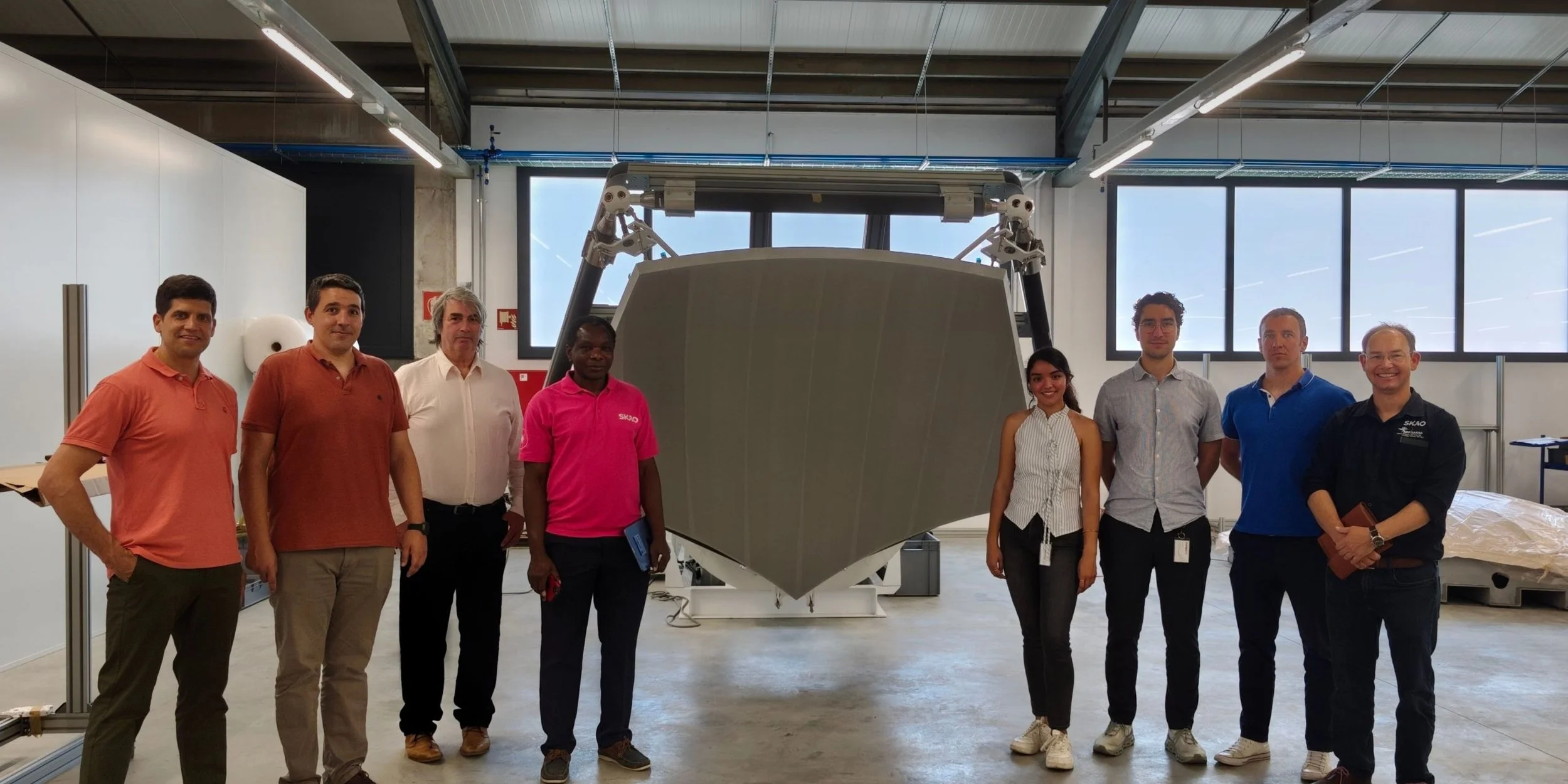
Last May, a new milestone was reached in this major project: the Factory Acceptance Test (FAI) for the construction of the subreflectors for the SKA Observatory’s telescope in South Africa, known as SKA-Mid. This is a very important milestone, as the FAI validates both the product (the subreflector) and the associated production process, marking a turning point (design and planning) and a transition (to series production) in the project. Both EOSOL (an engineering services company) and COMPOXI (specializing in the design and production of composite materials) have worked diligently in recent months in close collaboration with SKAO to ensure that the product meets the stringent requirements and that the production process is valid and robust enough to carry out the series production of the 44 units.
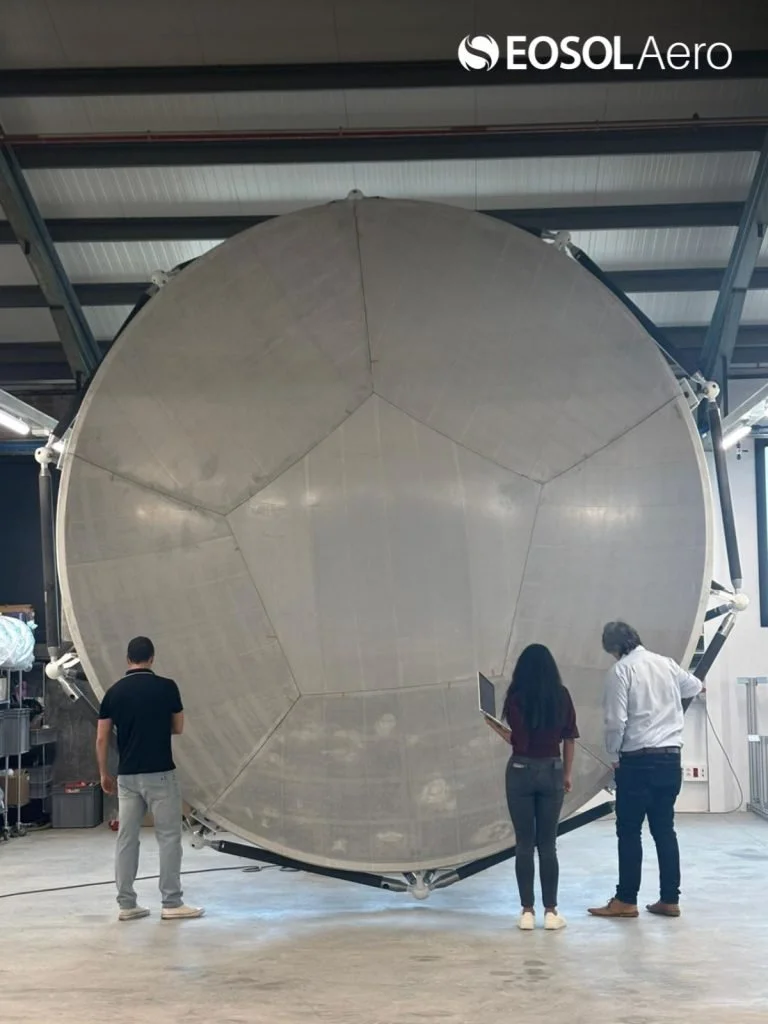
First unit review of the SKA-Mid radio telescope subreflector at Compoxi facilities.
This milestone has been achieved through excellent teamwork among the companies involved. In addition to meeting the established objectives, a product improving the initial specifications has been developed. Specifically, the team worked on developing a robust and mechanically stable product (with an overall RMS below 0.2 mm), with high reflectivity (above 99.9%), designed to operate for the telescope’s projected 50-year lifespan in the harsh environment of the Karoo region in South Africa.
The subreflector is a critical component of the antenna, concentrating the signals collected by the main reflector. The subreflector is a 4.5 m structure made of composite material and metallized to achieve the electromagnetic and mechanical properties required for the project.
“The approval of the FAI (First Article Inspection) for the subreflector manufactured by EOSOL and COMPOXI allows us to continue producing more units and to keep contributing to the construction ofthis groundbreaking international telescope . Thanks to the entire SKAO, Spanish Ministry of Science, Innovation and Universities, and CDTI team for your unwavering support. We continue making history together,” says Mikel Pinies, EOSOL Project Manager for the SKA project.
Following the FAI, the project enters a new phase. Having completed the prototyping and planning stages, the project now enters the construction phase. Production will take place at COMPOXI’s new facilities in Girona (Spain). This state-of-the-art, 3,000 m² factory is equipped with all the necessary resources to undertake this type of project (the new facilities include two cleanrooms, a large autoclave, a paint booth and a metrology laboratory).
Within this large scientific engineering project, EOSOL (as the main contractor) together with COMPOXI are in charge of the construction of 44 subreflectors for the SKA-Mid telescope – currently under construction in South Africa.
The SKA Observatory is considered one of the greatest scientific engineering projects of the 21st century. Countries from all five continents are collaborating on the construction of the two largest arrays of radio telescopes on Earth. In Australia, the low-frequency array, known as SKA-Low, will eventually have 131,072 antennas spread over 74 km. In South Africa, SKA-Mid will have 197 parabolic antennas when complete (including the 64 from the MeerKAT radio telescope) spread over 150 km. Due to their size and the number of antennas, the SKA telescopes will represent a significant leap in resolution, sensitivity, and observation speed compared to other radio telescopes, allowing us to see more of the Universe in greater detail than ever before. The array’s design and processing capacity will also allow radio astronomers worldwide to study different parts of the cosmos simultaneously.
The Universe awaits!
This contract is partially funded by the European Union – NextGenerationEU, managed by the Spanish Ministry of Science, Innovation and Universities.
About Grupo EOSOL
The EOSOL Group is a global engineering, monitoring and technical support services company with experience in more than 40 countries around the world. The aerospace division develops antennas and RF components for the space, defence and scientific sectors. We provide our customers with high-performance antenna solutions. The division covers all tasks related to the study and implementation of antennas and RF components (feasibility study, detailed design, prototyping, qualification and production).
For more information, please visit our website
About Compoxi
Compoxi is a leading company in the design and production of composite structures. Compoxi combines advanced design, analysis, qualification and prototyping capabilities with industrial means that enable it to carry out serial production. Compoxi’s portfolio encompasses the design and production of primary structures for satellites and launchers for the space sector, structural components for aeroplanes, helicopters and UAVs for the aeronautical sector and critical elements for scientific and industrial structures.
For more information, please visit our website
About the SKAO
The SKAO, formally known as the SKA Observatory, is an intergovernmental organisation composed of member states from five continents and headquartered in the UK. Its mission is to build and operate cutting-edge radio telescopes to transform our understanding of the Universe, and deliver benefits to society through global collaboration and innovation. Its two telescopes, each composed of hundreds of dishes and thousands of antennas, are being constructed in South Africa and Australia and will be the two most advanced radio telescopes on Earth. A later expansion is envisioned in both countries and other African partner countries.
Together with other state-of-the-art research facilities, the SKAO’s telescopes will explore the unknown frontiers of science and deepen our understanding of key processes, including the formation and evolution of galaxies, fundamental physics in extreme environments and the origins of life. Through the development of innovative technologies and its contribution to addressing societal challenges, the SKAO will play its part to address the United Nations’ Sustainable Development Goals and deliver significant benefits across its membership and beyond.
The SKAO recognises and acknowledges the Indigenous peoples and cultures that have traditionally lived on the lands on which the SKAO facilities are located.