
VDEA: Pushing the Boundaries of VHF Subsurface Surfing
EOSOL, under ESA contract 4000141120/23/NL/VA, has led the development of the VDEA antenna, a 7.5-meter deployable VHF antenna designed to meet the requirements for the STRATUs mission (SaTellite Radar sounder for eArTh sUb-surface Sensing), an innovative Earth observation concept proposed by RSLab at the University of Trento, Italy. Although STRATUS is not an official ESA candidate mission, its associated technology and concepts have influenced subsequent ESA initiatives focused on Earth observation and climate change monitoring. In fact, STRATUS mission has been considered as a “commended mission idea” by ACEO during the Earth Explorer EE12 proposal evaluation.
Unlocking the Subsurface from Space
The antenna was intended to demonstrate the feasibility of the VHF radar mission in Low Earth Orbit (LEO), aimed at investigating subsurface water content - reaching up to 50 meters below ground - in Earth's polar and arid regions. The expected capabilities are beyond any airborne or ground-based survey. It will enable to map the basal topography and ice thickness, internal structure of the ice sheet or detect the subglacial hydrological system, amd but also to map aquifers in the Middle East and sub-Saharan Africa. Within this mission concept, the deployable antenna constitutes a key subsystem of the overall instrumentation.It would be the first Earth observation radar working in the range of 40-50MHz.
Technical Challenges and Innovation
During the antenna development, several challenges were faced. The primary challenge was the necessity to design and manufacture a deployable directive antenna that met stringent technical specifications in terms of power and circular polarization purity. This antenna needed to operate at 45 MHz with a 10 MHz bandwidth, support dual circular polarization radiation, and be compatible with the stowage volume constraints of the hosting platform. Furthermore, it was crucial that the required physical extension upon deployment was achieved to ensure compliance with the specified radiation performance criteria.
The VDEA antenna is based on dual polarization log-periodic antenna and comprised by 9 dipole stages, which harness routing was meticulously integrated in the deployable boom. On the platform side, the feeding network with two ports, ensures the right-hand circular polarization (RHCP) or left-hand circularly polarized (LHCP) radiation of the antenna. The high-power operation required for the radar mission directly impacts on the feeding matching network and the proposed harness. The manufacturing of the deployable boom was a challenge, yielding a compaction ratio of 17, required precise engineering, fabrication, and assembly to guarantee optimal performance.
Innovative Testing: Drones and Zero-G Simulation
Last but not least, the antenna verification activities were also a challenge. Due to the lack of sufficiently large anechoic chamber for such very low frequency bands and large antennas, all the measurements had to be conducted outdoors. The antenna necessitates an auxiliary structure to ensure replicating zero-gravity conditions during testing. This system must be engineered to compensate for the antenna’s weight as it deploys or is manipulated, while also ensuring proper alignment and horizontal orientation of the dipoles. The implementation of this support structure increases the sophistication of its design, the rigor of fabrication, and the delicacy of assembly.
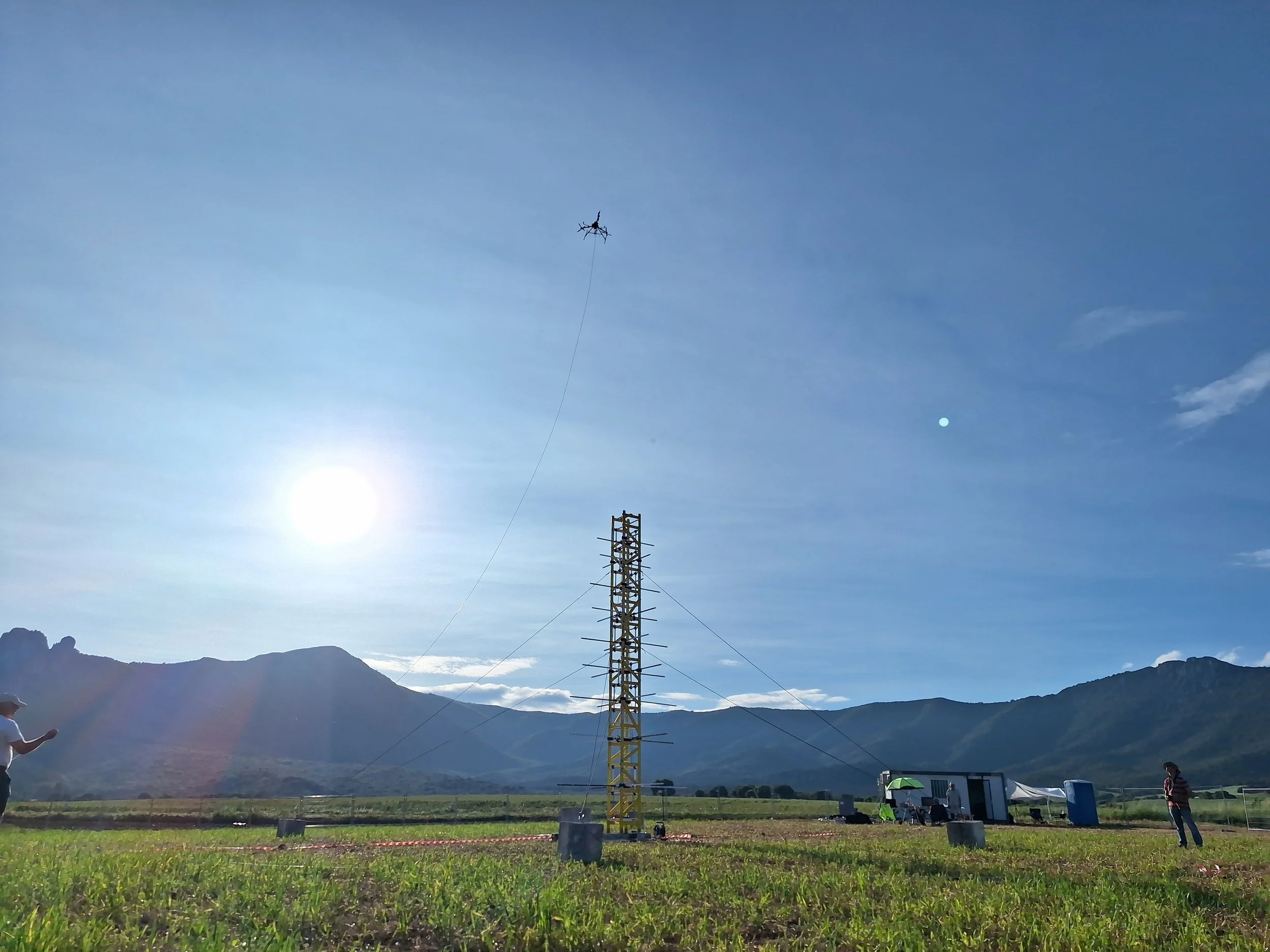
To characterize the antenna's performance without the risk of moving the delicate 7.5-meter structure, the team utilized a unique drone-based measurement method. By flying drones around the stationary antenna, the team could acquire the radiation pattern with high precision. This phase was supported by AEROXESS, who provided the dedicated drone and handled data post-processing.
Looking Ahead
Tests conducted on the 7.5m breadboard successfully validated the design, achieving Technology Readiness Level 4 (TRL 4). The project concluded in September 2025, and the team is now defining the roadmap for future development and space qualification.